-
Artist

-
Works
-
Paul McCarthyCSSC DOG GOD, 2023acrylic on canvas panel96 x 132 in (243.84 x 335.28 cm)
-
Paul McCarthyA&E, AASSHOLHOLE, 2023acrylic on gessoed panelDiptych: 60 x 120 in (152.4 x 304.8 cm) overall
Each 60 x 60 in (152.4 x 152.4 cm) -
Paul McCarthyA&E HEAD SPIKE, 2023acrylic and collaged magazine on canvas panelDiptych: 96 x 144 in (243.8 x 365.8 cm) overall
Each 96 x 72 in (243.8 x 182.9 cm) -
Paul McCarthyA&E, SHE SAID, 2023acrylic on gessoed panel72 x 96 in (182.88 x 243.84 cm)
-
Paul McCarthyCSSC A&E CUT UP, 2023acrylic and collaged magazine on canvas panel96 x 132 in (243.84 x 335.28 cm)
-
Paul McCarthyCSSC GOD COD, 2023acrylic and collaged magazine on canvas panel96 x 132 in (243.84 x 335.28 cm)
-
Paul McCarthyA&E, EEVAADOOLF, 2024pencil and pastel on paper48 x 36 inches (121.9 x 91.4 cm)
-
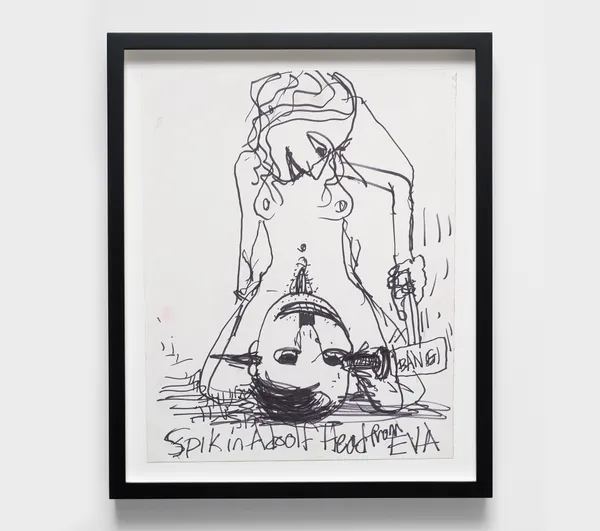
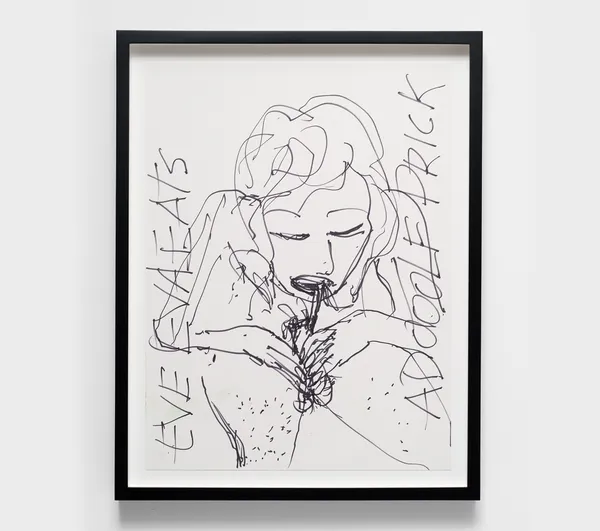
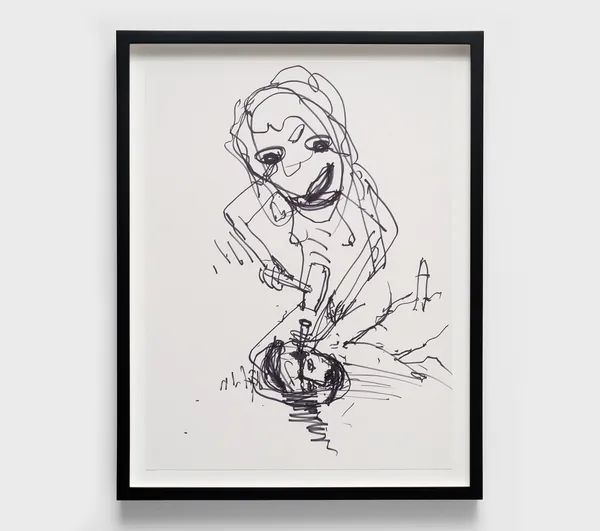
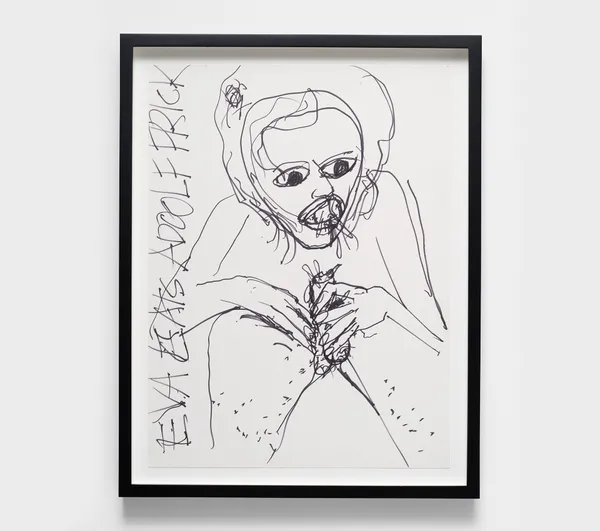
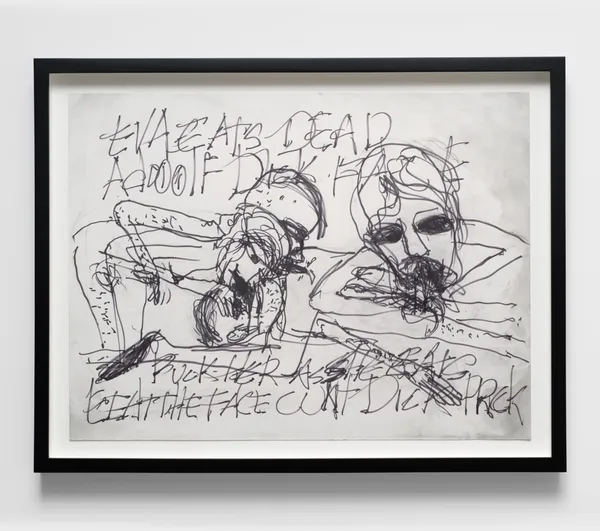
Paul McCarthyA&E, EVA EATS, 2021marker on paper18 x 14 in (45.7 x 35.6 cm)
-
Paul McCarthyA&E, EVA EATS, 2021marker on paper24 x 18 in (61 x 45.7 cm)
-
Paul McCarthyA&E, EVA EATS, 2021marker on paper24 x 18 in (61 x 45.7 cm)
-
Paul McCarthyA&E, EVA EATS, 2021marker on paper24 x 18 in (61 x 45.7 cm)
-
Paul McCarthyA&E, EVA EATS, 2021marker on paper18 x 24 in (45.7 x 61 cm)
-
Paul McCarthyA&E, PAIN LANGUAGE, 2024pencil and pastel on paper48 x 36 in (121.9 x 91.4 cm)
-
Paul McCarthyA&E, A/A Murder E/E Suicide, 2022silicone, clothing, dirt, fake blood, cane, wood65 x 37 x 78.5 in (165.1 x 94 x 199.4 cm)
-
Paul McCarthyCSSC Banker, Ronald, Blood Dirt Face, 2016silicone, clothing, dirt, table40.5 x 72 x 32 in (body: 11.5 x 72 x 32 in, table: 29 x 72 x 29.5 in)
-
-
Text
AAAAAAHEHEHE
He was carried through the exit to the back street and lifted into a police car. The siren began to scream and at first he thought he was making the noise himself. He felt his lips with his hands. They were clamped tight. He knew then it was the siren. For some reason this made him laugh and he began to imitate the siren as loud as he could.
— Nathanael West, The Day of the Locust (1939)
West’s short novel, set in 1930s Hollywood, is my favorite work of fiction to hate-read. It is so damn good, outplaying even Flannery O’Connor in its viciousness and, dare I say, grace. It has also come to mind confronting Paul McCarthy’s work before, but, here, now, because of this targeted and timely exhibition of an array of recent paintings, drawings, sculptures and photographic stills from a major video work, it would not fade. The passage quoted above is the end of the story, just after the protagonist—an artist—was extricated from the clutches of a Hollywood Boulevard movie premiere that went bloody. Having along the way scraped himself out of atrocities like repeated cock-blocking and a pathetic cock fight, all the while trying to complete a painting called The Burning of Los Angeles, what else is he to do but scream and laugh? The painting for sure is doomed.
For decades McCarthy’s work has been as great as it gets in the devastating and cathartic human territory of the unstable razor-thin gap between screaming and laughing. Nonetheless, the totality of his enterprise embodies, fundamentally, grace under (extreme) pressure, lumps of coal to diamonds, emphasis on the lumps. Some might not agree that these works and their juxtaposition bring us anywhere near such a thing. If so, to them I would say look harder.
A couple of things about this exhibition make it particularly potent, at least for me. First it is built around a cycle of large-scale paintings that prove that McCarthy is a painter as much as everything else he very much is. Second it is what I want to call an exceptionally “multiversal” experience, made all the more impactful by the missing elephant of the moving image. Even though it looms over everything here, mainly in the form of the recent and massive video works CSSC Coach Stage Stage Coach (2016–ongoing), and A&E, Adolf & Eva, Adam & Eve (2020–ongoing), everything here emphatically (eerily?) stands still. Intermingled (cross-bred) with works that jettison Adam and Eve (yeah, them) from the brutality of the stage coach scenarios and land them in their own psychosexual mess (I am not proclaiming they are also Adolf and Eva, but this is a multiverse …), everything here is interconnected at the hip. Bodies on top of bodies underneath bodies, all at once penetration, evisceration, burial, redemption.
Let’s say grace.
Two three-dimensional bodies (in-the-round, so to speak) lie in state here. Sculptures. They ground this multiverse in so-called reality, albeit of the pre-CGI special effects variety. They have mass, but their entropy is far slower than that of the real things. One is an exceptionally punctured Adolf, the other the dirty banker with a bowler hat from the stage coach. They both get it and take it in the paintings and the drawings on view here, from Eva in the former and the berserk Dogs in the latter. One of the largest paintings, CSSC A&E CUT UP (2023), even manifests the cut up as a rift directly slamming together two of the universes in McCarthy’s arsenal. Maybe the figures in The Burning of Los Angeles would remind me of those in McCarthy’s paintings?
The paintings are what got me most turned on about this exhibition because I have known for a long time that not only can McCarthy paint, but that he knows painting because he has actually looked at it. This was confirmed for me by one of his masterpieces, the video called, rightly so, Painter (1994). When speaking with him about this exhibition, I got off track (or did I?), going on and on about the promiscuous intermingling of abstraction, expression and figuration in mid-20th century New York painting and, by extension, what was happening on the west coast, Europe, and elsewhere. I am such a nerd I even brought up the work of Lester Johnson!
Then this:
Paul: “Adolf and Eva or Adam and Eve or Arts and Entertainment.”
Me: “or Abstract Expressionism.”
Paul: “America, Europe.”
Me: “America, Europe, yeah.”
McCarthy told me about how many of his works are done in character: “I would draw my character as like the pirate or whatever, but it’s not really like I’m a pirate. I’m not really trying to be a pirate. It’s because I use the voice and I talk a lot when I’m drawing, right? And it’s a way of kind of letting go. There’s something about letting go.”
Terry R. Myers
-
Installation Views
-
-
Press
-
PAUL MCCARTHY’S EXHIBITION “CSSC, COACH STAGE STAGE COACH, A&E, ADOLF & EVA, ADAM & EVE, SAMPLES” AT THE JOURNAL GALLERY, LOS ANGELES
PurplePurple, 25 February 2026 -
Is Paul McCarthy the Most Dangerous Artist in LA?
Vanity FairNate Freeman, Vanity Fair, 25 February 2026 This link opens in a new tab.
-
-
Events