Louis Eisner
-
Biography

-
Works
-
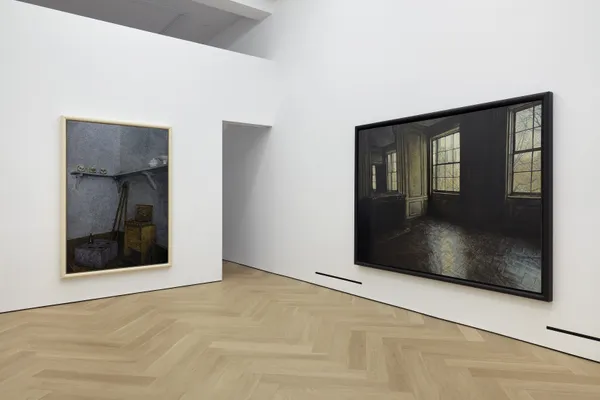
Louis EisnerStudio, 2026Oil on canvas72 x 48 in (182.9 x 121.9 cm)
Framed 76.75 x 52.9 x 3.3 in (194.9 x 134.3 x 8.4 cm) -
Louis EisnerLibrary, 2026Oil on canvas64 x 84 in (162.6 x 213.4 cm)
Framed 69 x 89 x 3.3 in (175.3 x 226.1 x 8.4 cm) -
Louis EisnerGallery, 2026Oil on canvas42.25 x 33.6 in (107.3 x 85.4 cm)
Framed 47 x 38.4 x 3.3 in (119.2 x 97.5 x 8.4 cm) -
Louis EisnerUncle Boogie, 2026Oil on copper12 x 9.5 in (30.5 x 24.1 cm)
-
Louis EisnerGlove, 2026Oil on copper12 x 9.5 in (30.5 x 24.1 cm)
-
Louis EisnerVase, 2023Bronze11.5 x 12 x 11 in (29.2 x 30.5 x 27.9 cm)
-
Louis EisnerHead, 2025Bronze6.5 x 10 x 7 in (16.5 x 25.4 x 17.8 cm)
-
-
Text
If you scratch the surface, as the saying goes, it does two things. It can reveal an underlying truth, but also leave a scar of insight.
If you scratch the surface of Louis Eisner’s slippery, somber canvases — which often show enigmatic, semi-composed spaces that might read like police photos from an art heist — you might be surprised to find that some of the image comes off like a mask. On the surface are carefully applied glazes of gelid oil color — lift the layers and you see the black-and-white image, like a sketch or blueprint of what’s to come, underneath. Traditional approaches like this are now called indirect painting, but as any art historian will tell you, five or six centuries ago this basic method of oil painting was just known as painting. It was part of what made a Van Eyck a Van Eyck.And “layers,” as any art director will tell you, are also part of what makes Photoshop Photoshop. That’s not a glib aside when discussing the painter’s work. The Los Angeles-raised, Columbia-educated painter has been associated with the ad hoc movement of faux-fauves reviving naïve figuration. But there’s nothing naïve here. Increasingly, what sets Eisner’s work apart is how he carefully considers and collapses distinctions between what we think of as entirely separate technologies, aesthetic genres and periods, creating new conversations between them. He then unites them with his own sensibility, a strong feeling of personal perspective and history, creating glimpses both out of and into this semi-public, cloistered consciousness. As a result, his synthesized and completed canvases manage to represent two very different things: one, the idealized mind and method of the classical painter; and two, the very real state of being human today, of filtering down the world into only what is essential.
So yes, Eisner may use techniques most associated with Old Master painters rather than Impressionists. But he looks for subjects—a hand in glove, a snap of the artist’s brother, a photo of Cézanne’s studio, an underexposed picture of a dark, parquet-floored room—with the same sense of l’observation passionnée that Baudelaire used to define “The Painter of Modern Life,” over 150 years ago. At the same time, his subjects intuitively echo the spontaneous, often random way we use the camera-phone today—and how it has become a painter of modern life itself.
In a similar blurrealist reversal, instead of using photography as the pre-Raphaelites did, to capture every detail of a perfect fantasy, Eisner de-escalates. He paints from photographs, but introduces a sense of 1980s-era granularity to his paintings (or noise, as Photoshop calls it, which can boost or reduce it). This boosts the offhand, snapshot feeling they have of paper-photo objecthood (a lo-fi quality that DSLRs and megapixel sensors are doing their best to delete). And it’s that frozen split-second, the ephemeral eternal, which might be one of the truest expressions of contemporary art. Micro over macro, personal and universal, minimal and maximal, indirect and direct—Eisner compresses all these layers and more into one millimeter-thin oil-emulsion film.David Colman
-
Q&A
-
Installation Views
-